
A fuel card was never a payment method. It was a control system.
Electrification does not replace that instrument. It breaks it into three unrelated contexts, each with a different counterparty, a different payment model and a different shape of data.
01 The instrument
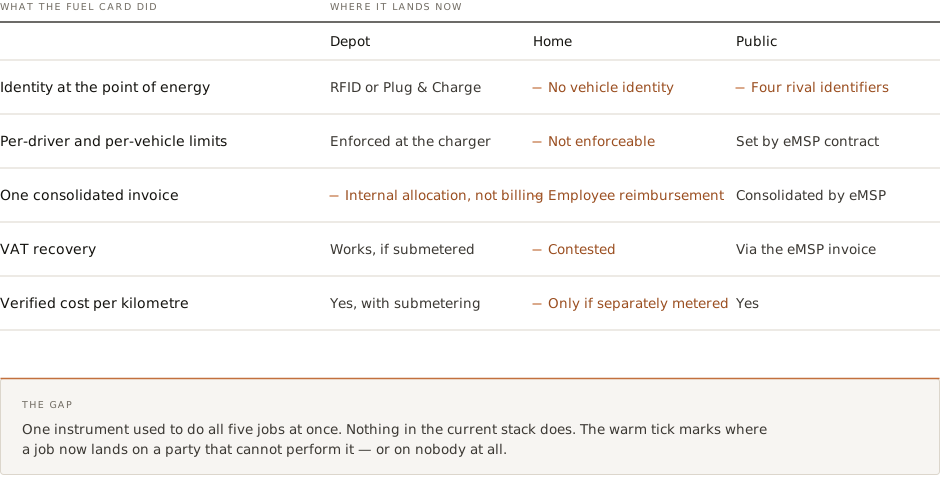
A fossil fleet ran on a closed-loop card that quietly did five jobs at the same time: it identified the vehicle at the pump, enforced limits per driver and per vehicle, produced one consolidated invoice, made VAT recoverable, and gave the fleet manager a defensible cost per kilometre.
Nobody bought it for the payment. They bought it for the control and the data. That distinction is the whole problem, because when a fleet electrifies, the payment part is the easiest thing to replace and the other four are the hard part.
02 In one view
03 Three contexts
The same vehicle, three different problems.
Not a transaction at all.
Depot charging is energy drawn from the company’s own connection. There is no acquirer, no scheme, no merchant. What looks like a payments problem is actually a submetering and internal cost-allocation problem, and the tooling for it usually sits with facilities rather than with fleet.
Get the submetering wrong and the VAT position, the per-vehicle cost and the driver-level attribution all degrade at once — silently, because nothing fails.
The hardest one, and the one nobody scoped.
An employee charges a company vehicle on a domestic supply, at a domestic tariff, on a meter the employer does not control. The money has to travel backwards — from the employee to the company — which makes it a reimbursement question rather than a payment one, with a metering-accuracy problem underneath and a benefit-in-kind question on top.
Reimbursement is where fleet electrification programmes quietly lose credibility with drivers.
Treat it as a payments integration and it will not work. Treat it as a metering, tax and payroll question with a payment at the end and it will.
Four identities for one driver.
On public infrastructure a driver may be recognised by an RFID token, an eMSP app, a vehicle certificate under Plug & Charge, or not recognised at all when they pay ad-hoc by card. Each route produces a different record, held by a different party, arriving on a different timetable.
Reconciling one driver and one vehicle across those four identifiers is the central data failure of fleet electrification. Roaming settlement between charge point operator and e-mobility service provider sits underneath it, and the fleet sees only whatever survives that chain.
04 What is actually needed
Restore the five jobs, or say plainly which ones you are giving up.
A fleet manager needs one identity per vehicle across all three contexts, controls that hold wherever energy is drawn, a single reconciled view of cost, a defensible VAT position, and a cost per kilometre that survives an audit.
Parts of that can be assembled today from existing components. Parts cannot, and the honest answer is to name which, decide who carries the gap, and design the process around it rather than pretending a product closes it.
05 Where I help
- Payment and identity architecture across the three contexts
- How a vehicle is recognised at depot, at home and in public, and what it takes to make those a single identity. Output: an architecture recommendation and the reconciliation model behind it.
- Home reimbursement design
- Metering approach, tariff treatment, reimbursement mechanism and the tax questions attached. Output: a design your payroll and tax advisers can sign off.
- Data and settlement review
- What each counterparty actually delivers, on what timetable, and where the record breaks. Output: a gap assessment against what the fleet needs to report.
- Commercial terms with eMSPs and CPOs
- Pricing, roaming exposure, data rights and service levels. Output: a negotiation position with the reasoning behind each ask.
Advisory only. Delvant does not perform certification, audit or penetration testing, and gives no tax or legal advice.
The regulatory question underneath — why the limited network exclusion is under pressure.
Start a conversation